
DECK: Two Brands, One Mispricing
Value Gap Analysis | March 2026

Deckers Outdoor Corporation is not a complicated business. It owns two shoes brands, HOKA and UGG, which together account for 96% of its revenue. It outsources all manufacturing, carries no factory debt, generates significant free cash flow, and has been buying back its own shares aggressively. Yet the stock trades near five-year lows relative to peers on every earnings-based multiple. The question this analysis tries to answer is whether that discount reflects genuine risk or genuine mispricing.
The answer, based on the evidence, is mostly the latter. There is a real value gap here. The timing, however, is not yet right to act on it.
What Deckers Actually Is
HOKA started as a niche product for ultra-endurance runners, known for its thick, cushioned soles. It has grown into one of the most recognizable names in performance footwear, currently number one in road running above $140 in the US. The brand’s growth over the past three years has been staggering: a 36% compound annual rate, driven largely by distribution expansion rather than price increases.
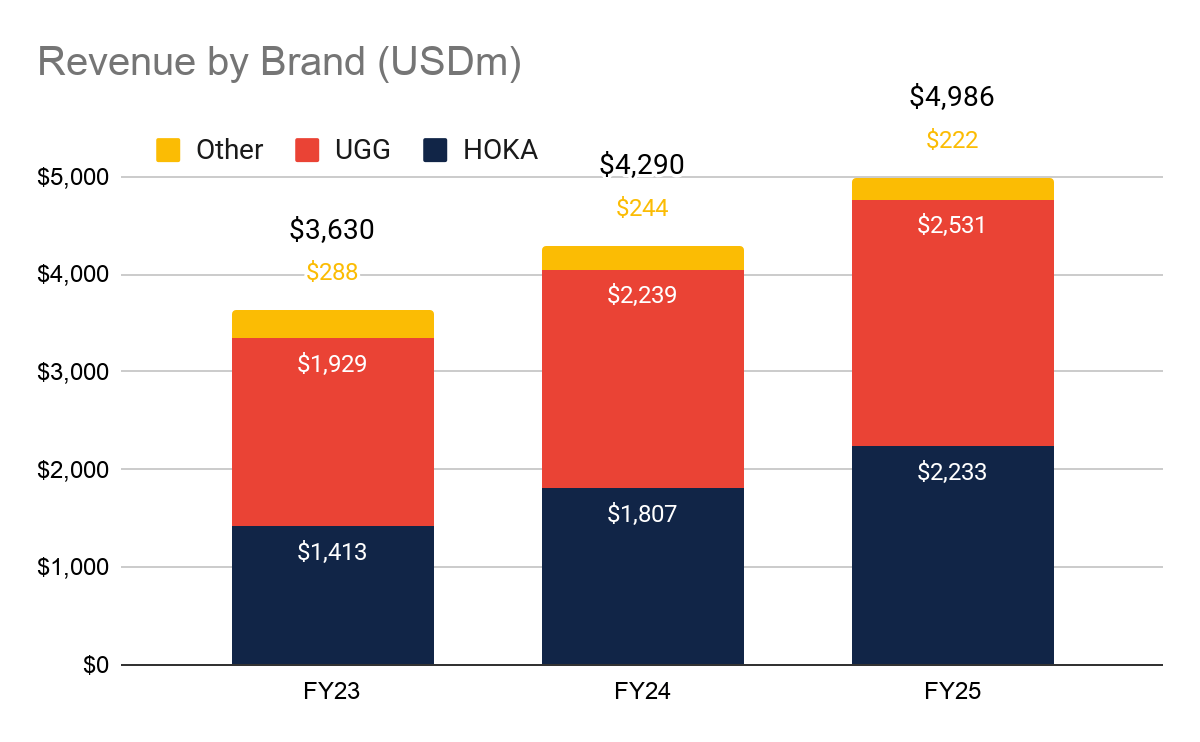
UGG is the older, larger business. Famous for its sheepskin boots, it has historically lived and died by a few months of the year. Management is in the middle of converting it into a year-round lifestyle brand, pulling levers including new sneaker categories (the Lowmel more than doubled revenue in one quarter), men’s expansion, and collaborations with Sacai and Palace. The closest comparable is Birkenstock, which pulled off a similar transition over the past decade, though UGG is doing it at a larger revenue base and across more categories simultaneously.
Both brands operate in markets with real runway. Running is a structural tailwind. Comfort lifestyle footwear is fragmented and growing. Neither brand is close to saturating its global distribution potential.
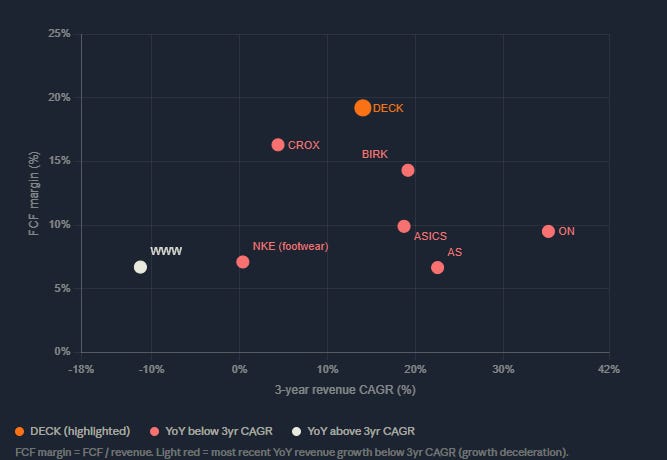
The business model behind both brands is the same: asset-light manufacturing, selective distribution, full-price discipline. Deckers owns no factories. Every dollar of revenue growth falls through at variable cost only. The result is a free cash flow margin that is the highest in its peer group, and a return on invested capital of approximately 100%, a level no peer comes close to matching.
The Valuation Picture
At a current share price around $100, Deckers trades at roughly 9x EV/EBITDA and 15x trailing P/E. The peer median sits at 21x EV/EBITDA and 31x trailing P/E. That is a 57% discount on earnings-based enterprise value and a 52% discount on earnings per share. Both discounts are at or near five-year wides.
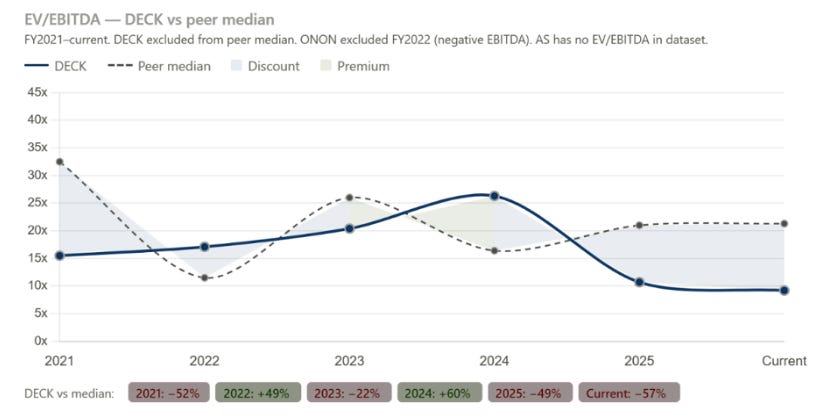
The forward P/E comparison is more instructive. Once growth premiums are stripped out of peer multiples, the true discount narrows to around 22%. More tellingly, the spread between Deckers’ trailing and forward P/E is essentially flat, meaning consensus currently prices in zero earnings growth. Every other peer in the group shows meaningful expected earnings uplift. The market is pricing in stagnation for a business that has compounded revenue at 17% annually for three years.
A reverse discounted cash flow analysis confirms the signal from a different angle. At a $100 share price and a 10% cost of capital, the market is implying perpetual profit growth of roughly 2.5%. That is below Deckers’ current 7–8% revenue growth rate and below the long-term growth rate of the global footwear sector, even after assuming meaningful margin compression from tariff headwinds in the near term.
A two-stage DCF with 6% growth over five years, a 3.5% terminal rate, and that tariff compression baked in, implies a fair value of approximately $135, around 35% above current levels.
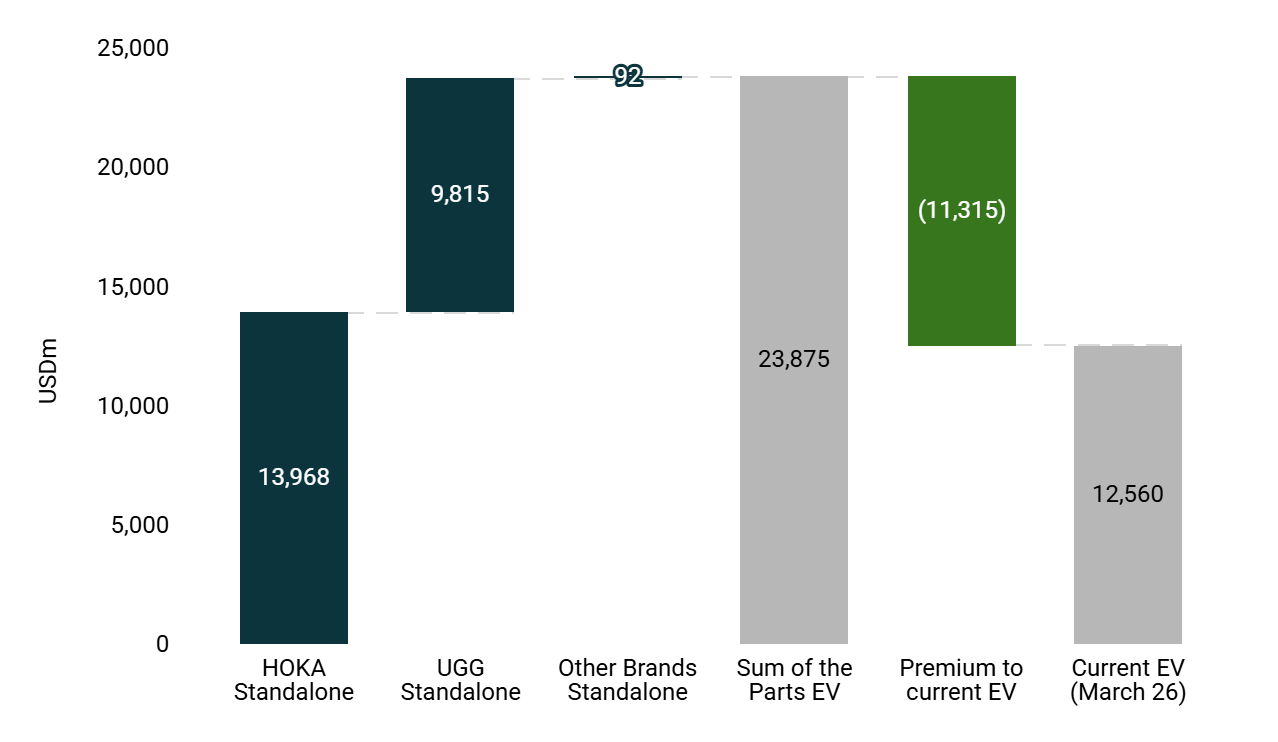
The most striking valuation approach, though, is the sum of the parts. Splitting the peer group by brand fit, applying performance running multiples to HOKA and comfort lifestyle multiples to UGG, and valuing each brand on its own EBITDA, implies a combined value of roughly $24bn. The current enterprise value is around $12.5bn. HOKA, valued on its own against comparable peers, would be worth more than the entire consolidated company is priced at today.
The discount is not explained by weak operations. Deckers is the strongest margin performer in its peer group, the most capital-efficient, and among the fastest-growing. The gap between what it earns and what the market is willing to pay for those earnings is the definition of a value gap.
Why I am Waiting
The value gap is real. The timing is not yet right.
The entire footwear sector has been under downward price pressure for six months, driven by two overlapping forces: US tariff uncertainty and a consumption slowdown. Deckers withdrew its full-year FY2026 guidance in September 2025, citing an estimated $185M tariff impact on cost of goods sold. That withdrawal removed the earnings visibility the market typically needs to re-rate a stock, and the gap has widened since.
This is a summary of the full value gap analysis. The complete version, including the detailed peer valuation table, ROIC comparison, consumer survey data, and options strategy framework, is available exclusively in the Flow Value Investing community on Discord. And its free.
Deckers is better positioned than most peers to absorb this. With $1.7bn in cash and no debt, the $2.5bn share buyback programme it launched in May 2025 is well-funded. It has already repurchased shares at around $110, meaningfully below its average buyback price of $149. Management is signalling conviction. But a buyback does not resolve tariff exposure, and it does not restore guidance visibility.
On momentum, Deckers is actually the relative outperformer in the group over the past three months, the only peer showing a positive return. Sentiment, measured across recent news flow, is neutral rather than bearish. The setup is not hostile, but it is not yet clear either.
The next material catalysts are the Bondi 10 and Clifton 11 launches in summer 2026, which are Deckers’ highest-volume revenue drivers, and the Q4 FY2026 earnings in May 2026, which will include the first full-year guidance since the tariff withdrawal. If macro conditions stabilise and those catalysts land well, the conditions for a re-rating are in place.
The Verdict
Positive value gap but challenging macro timing. Decision: wait.
The business is sound, the discount is large and structurally grounded, and the operational case for re-rating is strong. The question is not whether the gap closes, but when. That depends on factors outside the company’s control, specifically tariff resolution and consumer sentiment, more than anything inside it.
When the current market issues clear, this becomes a compelling trade. Until then, it goes on the watchlist.
This article represents a personal investment approach shared for educational purposes. It is not investment advice. Past performance does not guarantee future results. Always conduct your own research and consult a financial adviser before making investment decisions.